Neon Element
Neon is a colourless, odourless noble gas or group 18 chemical element in the periodic table with symbol Ne and atomic number 10. It is generally used for making ‘neon signs’ for advertising. It gives a reddish-orange colour in a vacuum discharge tube. However, when pure neon is used, it gives red signs. This gas will not react with any other substance due to its inertness or filled valence shell electron configuration. Therefore, prior to 1962, no true chemical compounds of this chemical element were known.
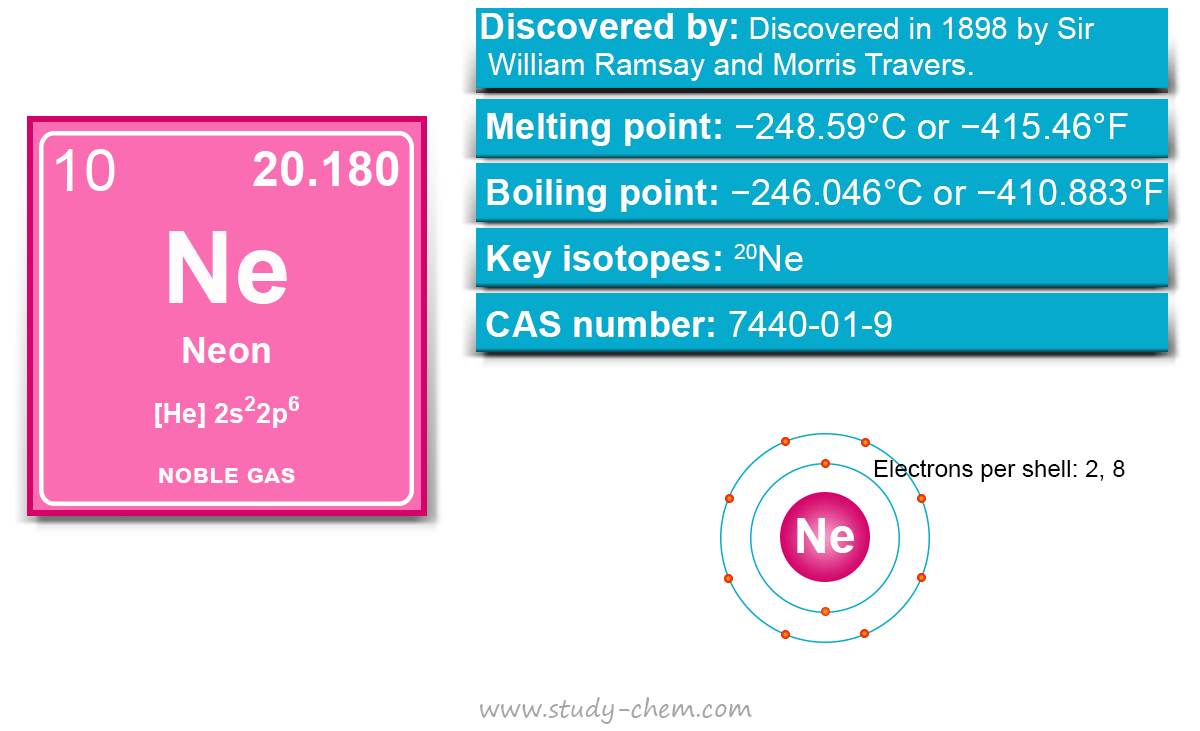
The noble gases like helium, neon, krypton, xenon, and radon in the periodic table were discovered through their physical properties such as spectral behavior and gas density. It is a non-toxic noble gas that does not play any biological role in living systems. This monoatomic gas is lighter than diatomic oxygen and nitrogen. However, the Ne balloon is rising more slowly in the air than the He balloon.
Neon is a non-conductor of electricity but it starts to conduct electric current under low pressure and under high voltage. Under this condition, ionization of Ne occurs. When exited ion returns to the ground state, it emits a characteristic red light. Such a principle is used in neon conduction lamps or neon signs.
Occurrence
Neon is present in the Earth’s atmosphere to the extent of about 18 parts per million (ppm) by volume in dry air. As well as other noble gases, it is obtained as a by-product of the liquification of crude argon obtained from air.
During fractional distillation, a fraction contains both helium, neon, and hydrogen. Helium is removed from this mixture by the action of activated charcoal. A lesser fraction of the noble gas Ne is also present in the Earth’s crust.
Neon is produced in the stars during nuclear fusion of oxygen and helium through the alpha-capture process. Therefore, it is more abundant in the cosmos than in Earth’s atmosphere.
Neon has three natural and stable isotopes: 20Ne (90.92%), 21Ne (0.26%), and 22Ne (8.82%). Therefore, it is the first chemical element that shows more than one stable isotope.
Discovery of Neon
William Ramsay and Morris Travers in 1898 isolated three new periodic table elements during low temperature distillation of liquid air. They isolated krypton gas by evaporating liquid argon at University College London. They expected to find out the lighter gas that is placed below the argon in the periodic table.
Ramsay and Travers repeated their experiment and allowed solid argon to evaporate slowly under reduced pressure. This time they were successfuly collected a new gas and put it into the atomic spectrometer. It gives a brilliant red glow with neon signs.
Ramsay named this new gas neon, which originates from the Greek word ‘neos’, meaning new.
Production of Neon Gas
The only commercial source of neon is the atmosphere because a large quantity of this gas is present in Earth’s atmosphere. Therefore, the noble gas Ne is generally extracted from Earth’s atmosphere through a process called fractional distillation of liquefied air.
During fractional distillation, the air is cooled to extremely low temperatures which liquefy the components of air. Now, the noble gas Ne can be separated from other gases due to its distinct boiling point (−246.046°C or −410.883°F).
Many of the noble gases can be isolated from natural gases. However, the extraction of neon from natural gas is less common.
Properties
This noble gas is a colourless, odourless monoatomic gas having a cp/cv ratio close to 1.67. In a solid state, it form face cented cubic lattice with a close-packed structure being the most space-economizing. Lack of chemical reactivity and high ionization energy of neon were the reasons to call it an inert element.
Discovery and Physical Properties |
|||
| Discovery | Discovered in 1898 by two British chemists, Sir William Ramsay and Morris Travers. | ||
| Origin of the name | The name of the element neon originates from the Greek ‘neos’, meaning new. | ||
| Allotropes | Ne | ||
| CAS number | 7440-01-9 | ||
| Relative atomic mass | 20.180 | ||
| Atomic number | 10 | ||
| Electron configuration | [He] 2s2 2p6 | ||
| Periodic position | Group 18, period 2, and block p in the periodic table. | ||
| Melting point | −248.59°C or −415.46°F | ||
| Boiling point | −246.046°C or −410.883°F | ||
| Density (g cm−3) | 0.000825 | ||
| State | Gas at 20°C | ||
| Crystal structure | Face-centered cubic (fcc) | ||
| Key isotopes | 20Ne | ||
| Thermal conductivity | 49.1×10⁻³ W/(m⋅K) | ||
| Heat of vaporisation (F2) | 1.71 kJ/mol | ||
| Molar heat capacity | 20.79 J mol−1 K−1 | ||
| Specific heat capacity | 1030.228 J kg−1 K−1 | ||
Chemical Properties |
|||
| ChemSpider ID | 22377 | ||
| Atomic radius, non-bonded (Å) | 1.54 | ||
| Covalent radius (Å) | 0.62 | ||
| Electron affinity (kJ mol−1) | Not stable | ||
| Electronegativity (Pauling scale) | Unknown | ||
| Ionisation energies (kJ mol−1) |
1st | 2nd | 3rd |
| 2080.662 | 3952.325 | 6121.99 | |
| Common oxidation states | None | ||
| Magnetic ordering | Diamagnetic | ||
Chemical Reactivity
Elemental neon is a stable, non-polar, and mostly unreactive noble gas due to its complete outer electron shell (1s² 2s² 2p⁶). Therefore, it is the first noble gas that contains eight electrons in its outer shell and molecules of this element contain only one atom. At normal temperature and pressure, it does not react to form any chemical compounds.
Before 1962, no true chemical compounds of this chemical element were known. Presently, some neon compounds exist and they are mostly ionic molecules and cage compounds. However, at very low temperatures, it can form a few compounds like neon fluoride (FNe−).
Position of Neon in Periodic Table
The atomic number of the noble gas neon is 10, and the electronic configuration of the element is 1s² 2s² 2p⁶. Therefore, noble gas neon is positioned in group 18 and period 2 of the periodic table.
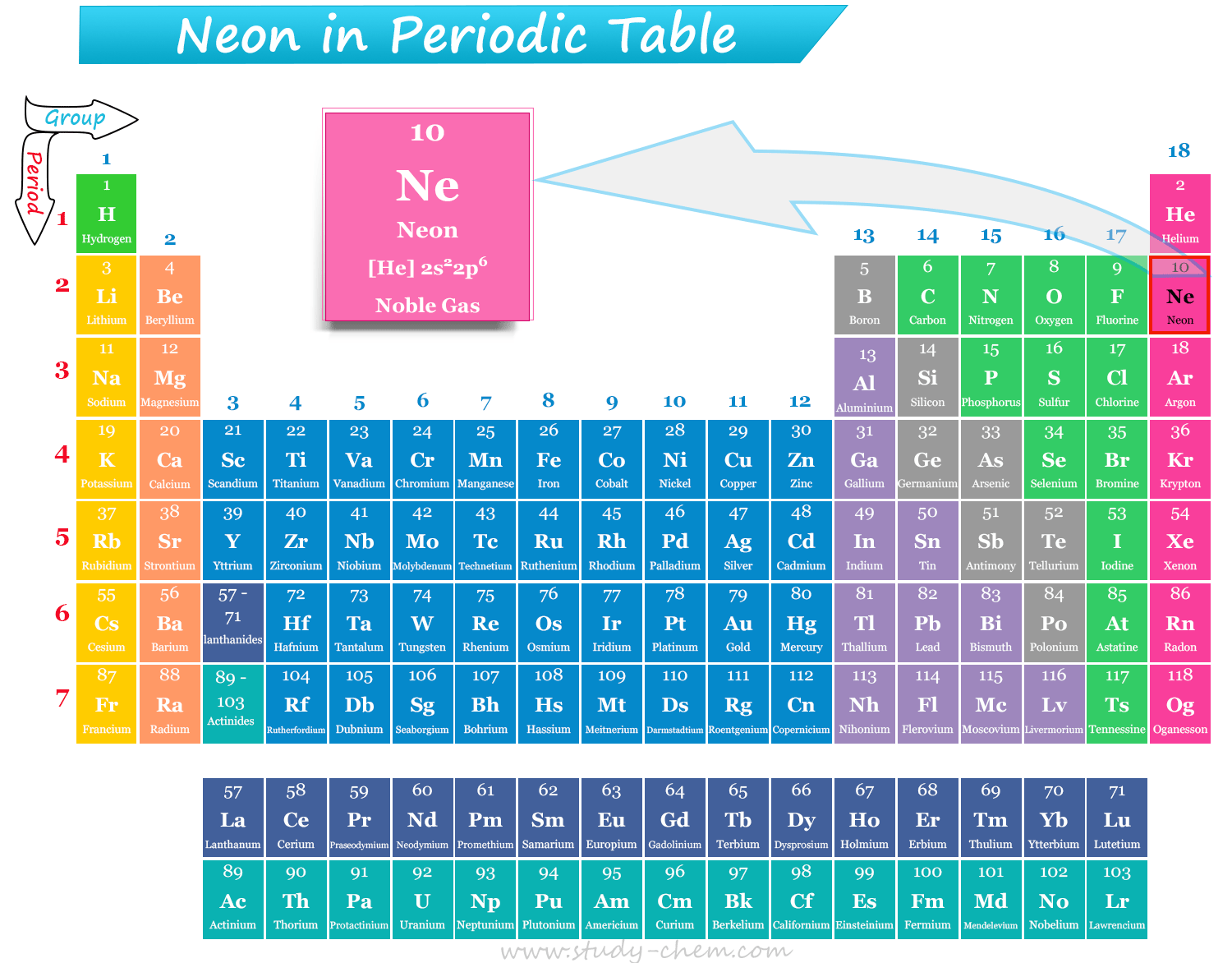
The valence shell electronic configuration of Ne suggests that it is a p-block element, which is placed after fluorine and the last member of period 2 in the periodic table.
Neon is the 10th element, or second member of group 18 or noble gases of the periodic table. Therefore, it is placed along with other group 18 elements: Helium (He), Argon (Ar), Krypton (Kr), Xenon (Xe), Radon (Rn) and Osgen (Os).
Facts About Neon
- The noble gas Ne glows with a characteristic red-orange light when a high-voltage electric current passes through it.
- Like other noble gases, neon is also chemically inert and non-reactive under standard conditions. The extreme inertness of group 18 elements is reflected in their monatomic nature.
- Neon is the fifth most abundant chemical element in the universe by mass, after hydrogen, helium, oxygen, and carbon.
- It is used in lightning because it provides bright, colorful light when electrically excited.
- Neon is the second-lightest noble gas that generally glows reddish-orange in a low-pressure vacuum discharge tube.
Uses of Neon Gas
The lack of chemical reactivity makes this noble gas valuable for use in various commercial industries. The current consumption is very small in neon tubes. Therefore, it is popular and economically valuable for advertisements.
- The so-called neon lights in advertisements contain a mixture of Ne with other noble gases.
- This colourless noble gas is also used for making high voltage indicators, photoelectric cells, driving equipment, lasers, etc.
- The liquid form of neon gas is a useful and important cryogenic refrigerant. The refrigerating capacity of this gas is much more than that of helium and more than that of hydrogen. It is also a less expensive refrigerant than helium because a huge quantity of this gas is obtained during the distillation of liquid air.
- Due to its non-reactive nature, neon gas can be used to make a certain type of vacuum tube. It glows reddish-orange in a low-pressure vacuum discharge tube.
- Gas mixtures containing high-purity neon are generally used in semiconductor device fabrication of lasers for photolithography.