Fluorine Element
Fluorine is a group 17 chemical element in the periodic table with symbol F and atomic number 9. The molecular form of fluorine (chemical formula F2) is a pale yellow-green, dangerously reactive gas. Elemental fluorine is the lightest halogen in the periodic table that reacts vigorously with almost all metals and non-metals. A huge amount of fluorine now prepared annually around the world for uses in nuclear power generation and production of various industrial compounds like hydrogen fluoride, chlorofluorocarbons, boron trifluoride (BF3), synthetic cryolite, Teflon, etc.
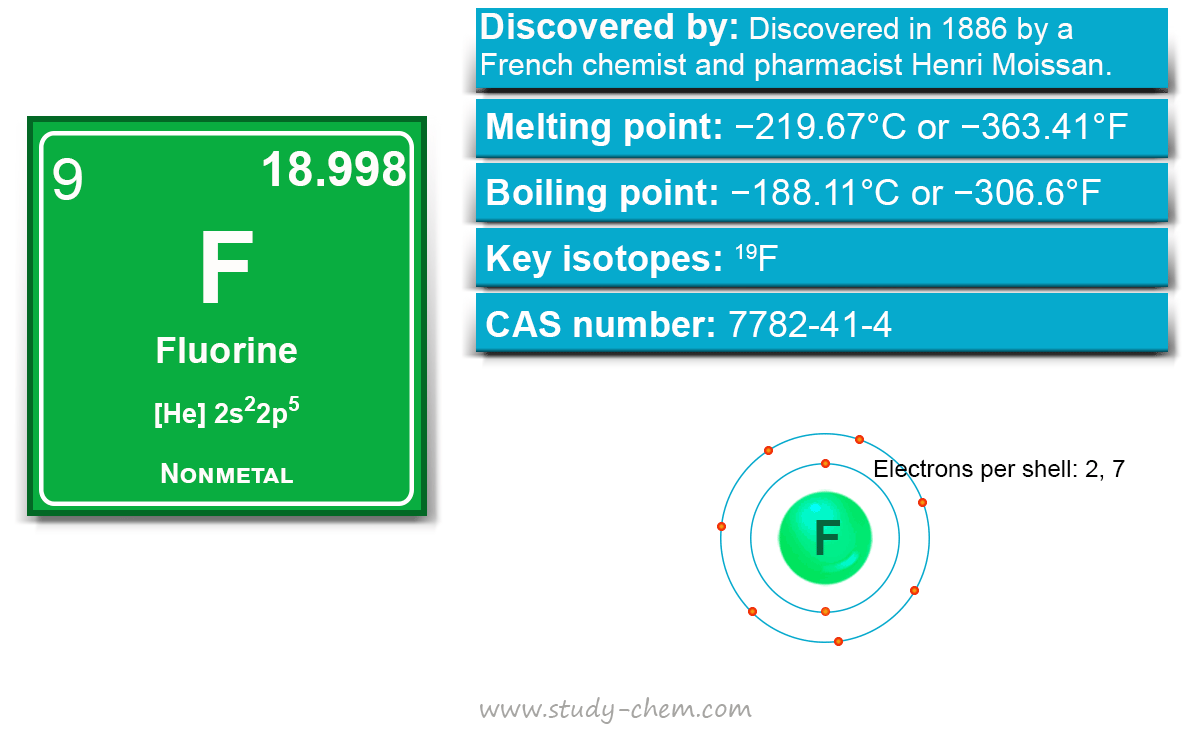
Fluorine is the 9th element, or first member of group 17 or halogens of the periodic table. Fluorine and its elemental form are highly toxic to the human body but fluoride ions are an essential component for strengthening teeth and bones.
Occurrence
The natural occurrence of fluorine is higher than that of chlorine. Among all periodic table elements, fluorine is the 13th most common element in the Earth’s crust. This periodic table element occurs in the Earth’s crust to the extent of 0.065%.
This periodic table element occurs in many common minerals such as fluorite or fluorspar (CaF2), cryolite (Na3AlF6), etc. Fluorine forms during electrolysis of potassium hydrogen fluoride or potassium bifluoride (KHF2) in anhydrous hydrofluoric acid.
Isotopes
The fluorine element has only one naturally occurring isotope with a mass number of 19. Therefore, 19F is the only isotope found in nature. This isotope has exceptional sensitivity to magnetic fields and use mostly in magnetic resonance imaging.
Eighteen radioactive isotopes have also been prepared with mass numbers from 13 to 31. Among these radioisotopes, 18F is the most stable isotope with a half-life of 109.734 minutes. The isotope 18F can be prepared by the nuclear reaction of protons with natural oxygen.
18O + p → 18F + n
However, other radioactive isotopes have half-lives less than 70 seconds. The isotopes 17F and 18F stabilize by β+ decay or electron capture while lighter isotopes stabilize by proton decay.
Discovery of Fluorine
In the early days, various chemists were aware that metal fluorides contain an unknown element similar to that of chlorine. However, they could not isolate this element due to its toxic and corrosive nature.
The corrosive nature of hydrofluoric acid was observed in the seventeenth and eighteenth centuries by many chemists including Humphry Davy and Scheele. Fluorine gas could not be prepared due to the following difficulties:
- Anhydrous hydrofluoric acid is a nonconductor of electricity while an aqueous solution can produce ozonized oxygen on electrolysis.
- There are no oxidizing agents that can oxidize a fluoride or HF to F2.
- Difficulties of operation due to high volatility and corrosive nature of HF.
English chemist Humphry Davy became ill when trying to produce this element from hydrofluoric acid. In 1869, British chemist George Gore found that a gas was liberated and reacted violently with his apparatus when an electric current was passed through liquid hydrofluoric acid. He suggested that the gas was fluorine, but he was unable to collect and prove it.
Finally, in 1886 the French chemist Henri Moissan prepared fluorine by electrolysis of potassium bifluoride (KHF2) dissolved in anhydrous hydrofluoric acid in a U-tube of platinum with platinum iridium electrodes. The volatility of hydrofluoric acid (HF) was tackled by using a bath of boiling ethyl chloride at −24° C.
Production of Fluorine
Industrial Production
The process of Henri Moissan is still employed during the production of fluorine in modern days. However, it is slightly modified. Fluorine is now prepared by electrolysizing molten K−HF mixtures having the compositions around KF−HF (melting point 240° C) to KF−2HF (melting point 70−100° C).
When using these compositions, the vapour pressure of HF is much lower than the original composition used by Moissan. The electrolyte is taken in a mild steel cell acting as the cathode. However, the anode is a central rod of non-graphitic carbon separated from the cathode by a porous diaphragm. An ungraphitized carbon anode is made from powdered coke compacted with copper.
The temperature of the cell is carefully monitored by placing heating and cooling coils around the cell. During the electrolysis, fluorine (F2) gas is evolved at the anode while hydrogen (H2) gas comes out from the cathode.
Anode Reaction: 2H+ + 2e− → H2
Cathode Reaction: 2F− → F2 + 2e−
Overall Reaction: 2HF → H2 + F2
Various precautions are needed for the production of such a highly reactive element fluorine.
- The electrolyte used for the production of F2 is highly corrosive and must be handled carefully.
- F2 is highly reactive and it combines explosively with H2 if not completely separated.
- Grease and other oxidisable substances must be thoroughly removed because such materials catch fire.
- Any graphite in the anode material is likely to form explosive graphite fluoride.
Laboratory Production
Chemical preparation of fluorine was achieved recently in 1986 by Karl O. Christe through the following reaction.
4SbF5 + 2K2MnF6 → 4KSbF6 + 2MnF3 + F2
SbF6 is a stronger Lewis acid and it displaced the weaker MnF4 which itself is unstable and decomposes to form MnF3 and F2.
Properties
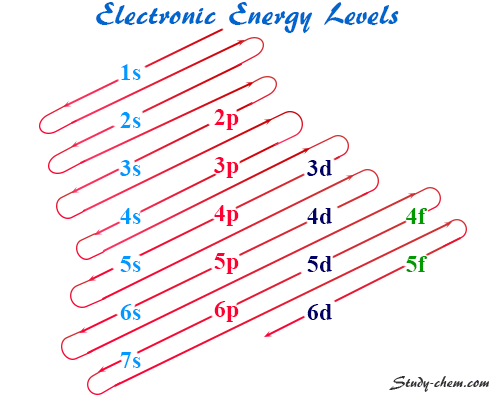
Fluorine atoms have nine electrons distributed by 1s2 2s2 2p5. Therefore, atoms of this periodic table element contain seven valence electrons and need one more to achieve an octet or nearest noble gas configuration. At room temperature, fluorine is a pale yellow diatomic gaseous molecule formed by covalent bonding between two F atoms.
Discovery and Physical Properties |
|||
| Discovery | Discovered in 1886 by a French chemist and pharmacist Henri Moissan. | ||
| Origin of the name | The name of the element is derived from the Latin word ‘fluere’, meaning to flow. | ||
| Allotropes | Molecular F2 | ||
| CAS number | 7782-41-4 | ||
| Relative atomic mass | 18.998 | ||
| Atomic number | 9 | ||
| Electron configuration | [He] 2s2 2p5 | ||
| Periodic position | Group 17, period 2, and block p in the periodic table. | ||
| Melting point | −219.67°C or −363.41°F | ||
| Boiling point | −188.11°C or −306.6°F | ||
| Density (g cm−3) | 0.001553 | ||
| State | Gas at 20°C | ||
| Crystal structure | Cubic | ||
| Key isotopes | 19F | ||
| Thermal conductivity | 0.02591 W/(m⋅K) | ||
| Heat of vaporisation (F2) | 5.57 kJ/mol | ||
| Molar heat capacity | For F | For F2 | |
| 15.652 J mol−1 K−1 | 31.304 J mol−1 K−1 | ||
| Specific heat capacity | 823.876 J kg−1 K−1 | ||
Chemical Properties |
|||
| ChemSpider ID | 4514530 | ||
| Atomic radius, non-bonded (Å) | 1.47 | ||
| Covalent radius (Å) | 0.60 | ||
| Electron affinity (kJ mol−1) | 328.165 | ||
| Electronegativity (Pauling scale) | 3.98 | ||
| Ionisation energies (kJ mol−1) |
1st | 2nd | 3rd |
| 1681.045 | 3374.17 | 6050.441 | |
| Common oxidation states | −1 | ||
| Magnetic ordering | Diamagnetic | ||
The element fluorine is just one electron short of the next noble gas neon and radily formation of fluride ion. This periodic table element always shows oxidation number or state −1 in its compounds. However, except for fluorine, halogens exhibit several positive oxidation numbers or states in their oxides, oxoacids, and interhalogen compounds.
Chemical Reactivity
Fluorine is the most electronegative and most chemically active element or nonmetal in the periodic table due to its extremely small size. Therefore, it combines directly with metals and almost all nonmetals. Oxygen, nitrogen, and noble gases (xenon and krypton) generally do not react with this element.
The reaction of fluorine with many other elements is vigorous and sometimes explosive. It makes a protective layer of fluoride with some metals like Fe, Cu, Ni, and Al. Such a protective layer prevents further reaction with F2.
The exceptionally high reactivity of fluorine may be assigned due to the low F−F bond dissociation energy. Such a low dissociation energy generally assigned due to large internuclear repulsion in the F−F bond and large inter-electron repulsion between the lone pairs of electrons on the two F atoms which have high charge density.
Position of Fluorine in Periodic Table
The atomic number of the halogen fluorine is 9, and the electronic configuration of the element is [He] 2s2 2p5. Therefore, halogen fluorine is positioned in group 17 and period 2 of the periodic table.
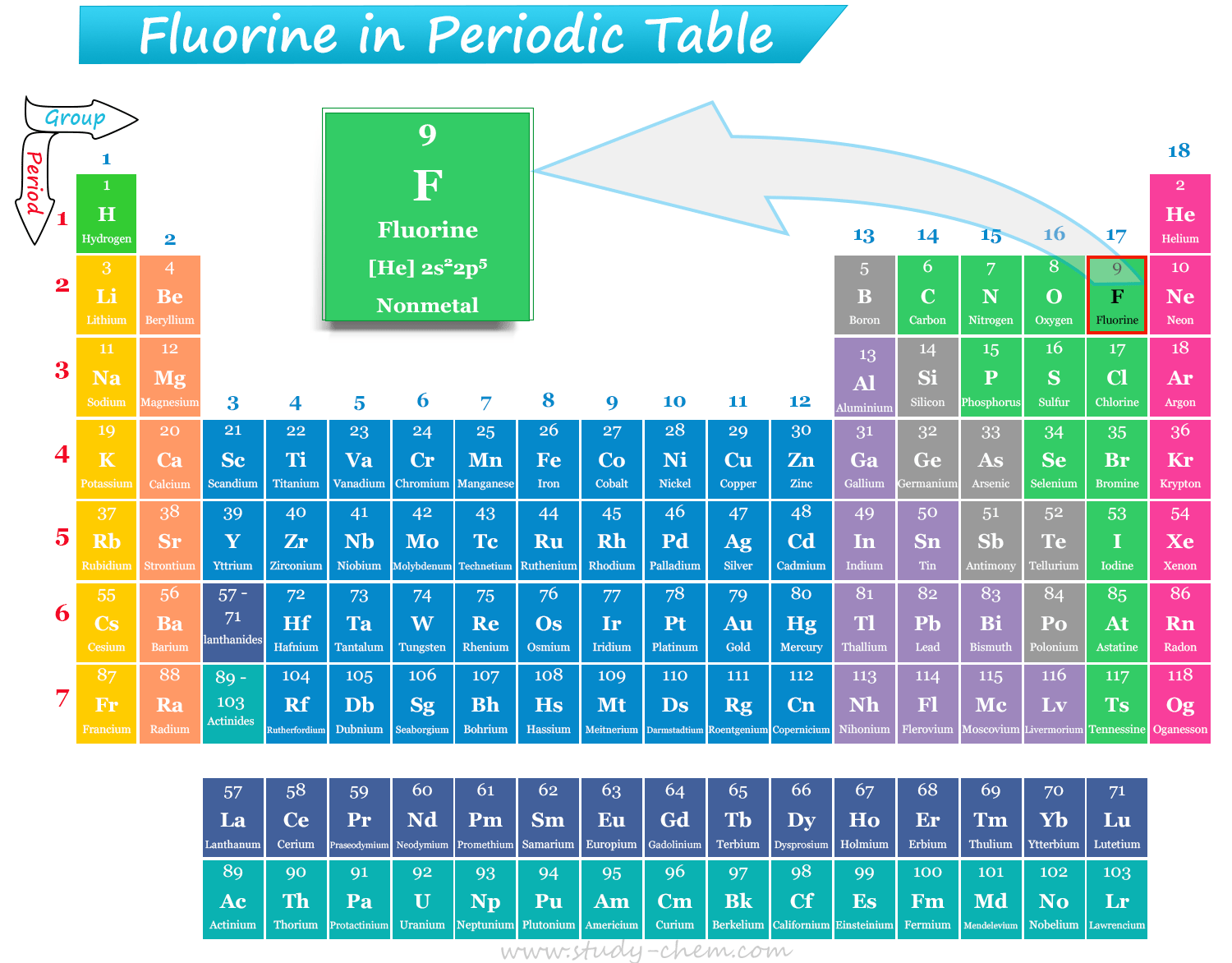
The valence shell electronic configuration of fluorine suggests that it is a p-block element, which is placed after oxygen and before neon in the periodic table.
Fluorine is the 9th element, or first member of group 17 or halogens of the periodic table. Therefore, fluorine is placed along with other group 17 elements: Chlorine (Cl), Bromine (Br), Iodine (I), Astatine (At), and Tennessine (Ts).
Interesting Facts about Fluorine
- The low bond dissociation energy of F2 and the small size of the F− ion generally promote the formation of ionic fluorides.
- The small size of the fluorine atom makes it resistant to polarisation.
- The low bond dissociation energy of fluorine results mainly from repulsion between the unshared pairs of electrons on two atoms.
- The high electronegativity and small size of fluorine generally give rise to strong hydrogen bonding in hydrogen fluoride.
Differences of Fluorine from Other Halogens
Fluorine differs remarkably from the remaining halogens in the following points:
- The small size of the fluorine atom and the fluoride ion.
- Highest electronegativity among all periodic table elements.
- Low bond dissociation energy of the F2 molecule.
- High bond energy of any element-fluoride chemical bond.
- Restriction of the valence shell electrons to an octet.
Uses of Fluorine
Due to high toxicity, the element could not be produced until the Second World War. However, a huge amount of fluorine is now prepared annually around the world for use in nuclear power generation and industrial applications. Hydrogen fluoride, chlorofluorocarbons, BF3, synthetic cryolite, and Teflon are some of the industrially important compounds of fluorine.
- The production of fluorine became necessary during the development of atom bomb and the installation of nuclear projects. Uranium hexafluoride obtained from fluorine is an important material that is used widely in the nuclear industry for the separation of uranium isotopes.
- The salts of fluorine or fluorides were used for a long time in welding and for frosting glass.
- Fluorspar is an important and highly effective flux in metallurgy that generally helps to remove impurities and improve the efficiency in the steelmaking process.
- The insulating gas sulfur hexafluoride obtained from this element use for dielectrics in making high-power electricity transformers.
- The highly reactive element fluorine also uses for making solvents and high-temperature plastics. For example, Teflon or polytetrafluoroethene is used for coating in frying pans due to its non-stick properties.
- Teflon also uses in cable insulation, plumber’s tape, and coating in waterproof shoes and clothing.
- In the early days, CFCs (chloro-fluoro-carbons) were used as aerosol propellants and refrigerants. However, due to their inertness, they can not be destroyed in the atmosphere but they diffuse into the stratosphere by destroying the Earth’s ozone layer. Therefore, they are now banned for use.
- Hydrofluoric acid uses for etching the glass because it leaves transparent and smooth impressions on the surface of the glass.
- Tungsten and rhenium are fluorinated to form volatile WF6 and ReF6. They are generally required in the vapour deposition of metals on machine components.
Biological role
Elemental fluorine is highly toxic to the human body but fluoride ions are an essential component for strengthening teeth and bones. Therefore, this periodic table element added sometimes in toothpaste to prevent dental cavities.
When the fluorides are below 2 parts per million (ppm) in drinking water, the water generally safe for drinking and prevents dental cavities. However, above the concentration, the teeth of the children become molten.
The average concentration of fluoride in the human body is about 3 milligrams. It causes toxic effects when the concentration is above the limit.