Definition of Covalent Bond
Covalent bond is defined as a force that holds together two or more atoms through the mutual sharing of one, two, or three electron pairs. Therefore, it is a chemical bond formed by mutual sharing of electron pairs between the atoms and each atom may attain a stable noble gas electronic configuration. The electron pairs that participate in this type of bonding are known as shared pairs or bond pairs and each atom contributes one electron to form an electron pair.
Covalent bonds are more common in organic chemistry than ionic bonds because all of the organic molecules are formed through covalent bonding. Such types of chemical bonds are generally formed between the atoms that have no electronegativity differences or very low electronegativity differences.
Formation of Covalent Bonds
It is easy to understand the formation of an ionic bond because an ionic bond is formed by electrostatic attraction between oppositely charged ions. However, it is much more difficult to gain an understanding of the formation of covalent bonding.
The bond holding identical non-metal atoms can not be explained by electron transfer because it is more reasonable when two atoms have widely different electron affinities. Therefore, hydrogen and fluorine combine to form hydrogen fluoride in this way. However, the properties of hydrogen fluoride differ widely from those of other ionic compounds because it is a non-conductor of electricity and it has a low boiling point.
Lewis in 1919, suggested that many non-ionic molecular compounds formed by the sharing of electrons between similar or dissimilar atoms whereby each atom can attain a noble gas configuration (either two electrons or an octet in the outermost shell).
Such types of bonds hold the bonding atoms because the attraction between the positively charged nuclei and the negatively charged shared electrons is greater than the repulsion between the nuclei of participating atoms. The strength of a covalent bond can be calculated by the energy required to break down such bonded atoms. Two nonmetals or a nonmetal and a metalloid generally form covalent molecules.
The Octet Rule
The octet rule shows that when two atoms form covalent bonds, they attain an inert gas configuration with an octet of electrons or ns2 np6 configuration. However, when a hydrogen participates in covalent bonding, it attains a 1s2 configuration.
There are many examples of molecules in which the octet rule breaks down. Therefore, the atoms have electrons eithier less than eight (incomplete octet) or more than eight (expansion of octet).
- Incomplete Octet: Beryllium (Be), boron (B), and nitrogen (N) atoms in BeCl2, BF3, and NO are surrounded by four, six, and seven electrons in their valence shell respectively while other atoms of these molecules obey the octet rule.
- Expansion of Octet: The central phosphorus atom in the PCl5 molecule is lined with five chlorine atoms to form five covalent bonds. Therefore, the phosphorus atom is surrounded by ten electrons and the octet is expanded. Similarly, both chlorine and iodine in the ICl3 molecule are surrounded by 6 + 4 = 10 electrons. The expansion of the octet is also found in SF6, OsF8, OsO4, etc.
Writing Lewis Structures for Covalent Compounds
For writing the Lewis dot structure, we can go with the following steps.
- Count the valence electrons of the combining atoms. If the species is a cation, then subtract one electron for each positive charge. However, for an anion, add one electron for each negative charge.
- The less electronegative and larger atom of a polyatomic covalent compound is considered the central atom.
- The symbols of all the participating chemical elements are written in the order in which they are connected.
- The dot or cross symbol is used for the representation of valence shell electrons.
- Covalent bonds are written by small straight lines or bars (−).
- The unshared valence shell electrons are also drawn as dots or crosses.
- However, the Lewis dot structure does not provide the shape or geometry of covalent compounds.
Limitations of Lewis Structure
- Lewis dot structure is useful only for main group covalent compounds, but it is not useful for transition metal compounds.
- Such a dot structure does not provide any clue to the shape of the covalent molecules.
- It can not explain many properties of some simple covalent molecules.
- It does not explain the polarity of covalent molecules.
Types of Covalent Bonds
Covalent bonds may be of three types: single covalent bond, double covalent bond, and triple covalent bond. Double and triple covalent bonds in oxygen and nitrogen molecules are also called multiple covalent bonds.
- Single Covalent Bonds: Single covalent bonds are formed by the sharing of only one electron pair between the bonded atoms of covalent molecules. Such a type of bond is found in hydrogen and water molecules, and it is also called a pi bond.
- Multiple Covalent Bonds: Such bonds are formed when the atoms are bonded together by sharing two or three electron pairs respectively. Multiple bonds are found in oxygen, nitrogen, ethylene, acetylene, and other compounds.
Polar and Nonpolar Covalent Bonds
Based on the polarity, there are two types of covalent bonds: polar, nonpolar, and coordinate covalent bonds.
Polar Covalent Bond
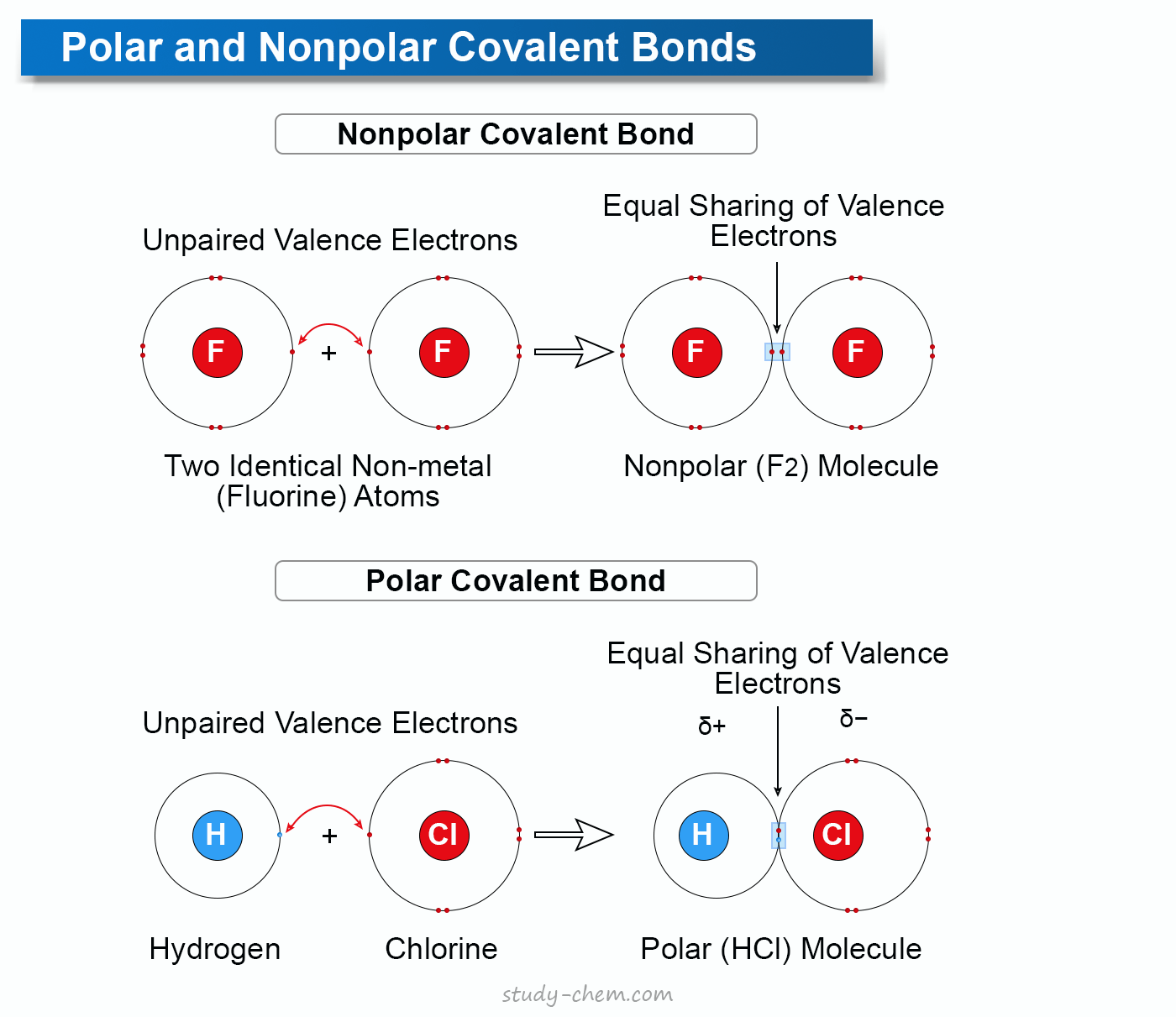
A polar molecule is one in which there is a separation of the centres of gravity of the positive and negative charges. When a covalent bond is formed between two unlike atoms or between two like atoms having different neighbours, the shared electron pair will not be equally shared by both atoms.
If an atom has a stronger attraction for an electron pair or has a greater electron affinity than other participating atom, the shared electron pair will be attracted towards the atom that has a higher electron affinity.
Such a type of permanent displacement of the electron pair towards atoms in the covalent bond can cause polarity in the molecule. Therefore, the bonds between two atmos which have some ionic character are called a polar covalent bond.
Water (H2O), chloroform (CHCl3), methanol (CH3OH), hydrogen chloride (HCl), and ammonia (NH3) are examples of polar covalent molecules.
Non-Polar Covalent Bond
The electron pair of two similar atoms can be shared equally by both atoms and the covalent bond will have no ionic character. Such a type of covalent bond may be regarded as the true or non-polar covalent bond.
The bonding between two alike atoms (H2, Cl2, Br2, O2, and N2) is non-polar. However, actually, covalent bonds also have ionic character. For example, the bond H−H in the H2 molecule also has about 2% ionic character. Such an ionic character arises from small contributions of ionic resonance structures to the total structure of the H2 molecule.
Coordinate Covalent Bond
In a purely covalent bond, each combining atom shares an electron equally to form an electron pair. However, a less equitable partnership, in which one of the atoms allows the other to provide both the electrons which are to be shared.
The rich latter partner is called the donor, and the former is the acceptor. The formation of the NH4+ ion from NH3 can be explained by a coordinate covalent bond.
NH3 + H+ → [H3N:→H]+
The combination of ammonia with boron trichloride can form a coordinate linkage.
H3N + BF3 → [H3N:→BF3]
The formation of the H3O+ ion (hydronium ion) can be explained by coordinate covalent bonding.
H2O + H+ → [H2O:→H]+
Properties of Covalent Compounds
- Covalent crystal lattices are built up of molecules, instead of ions. Therefore, the isolated and discrete molecules in covalent crystals are held by weak Van der Waals forces.
- The non-polar pure covalent molecules are generally insoluble in water but soluble in organic solvents like benzene, carbon tetrachloride, etc. However, in special cases, the solubility of covalent compounds in polar solvents may be facilitated through hydrogen bonding.
- Unlike electrovalent compounds, they are generally solids, liquids, and gases at room temperature. For example, chlorine is a gas, bromine is a liquid, and iodine is a solid at room temperature.
- The covalent compounds are generally soft, easily fusible, and volatile in nature because they are held together by weak intermolecular attraction.
- The covalent bonds are directional and many of them fomed positional and stereoisomerism.
- The conduction of electricity does not take place in liquid and fused state covalent compounds due to the absence of free electrons or ions. However, graphite is an exception, and it conducts electricity.
- The reactions of covalent compounds in solution show the characteristics of the whole molecules or of the constitutional functional groups. Such reactions can be carried out by the formation of covalent bonds and at a slow and measurable rate.
Difference Between an Ionic Bond and a Covalent Bond
Ionic and covalent bonds are the two main types of chemical bonds where two different types of attraction forces are responsible for such types of bond formation. The main differences between these two types of chemical bonding are:
| Ionic Bond | Covalent Bond |
| An ionic bond is a type of bond formed by the transfer of one or more electrons from an electropositive atom to an electronegative atom. | A covalent bond is a type of bond formed by the mutual sharing of one, two, or three electron pairs between two nonmetals or a nonmetal and a metalloid. |
| An ionic bond is formed by electrostatic attraction between oppositely charged ions. | The isolated and discrete molecules in covalent crystals are held by weak Van der Waals forces. |
| An ionic bond is always polar because it forms mutual attraction between a cation and an anion. | However, a covalent bond may be nonpolar or polar because it forms generally between the atoms that have no electronegativity differences or very low electronegativity differences. |
| Ionic bonds are stronger, and more energy is required to break down such a stronger electrostatic attraction. | Covalent bonds are weaker and comparatively less energy is required to break down such Van der Waals forces. |
| The formation of sodium chloride (NaCl) from a sodium (Na) atom and a chlorine (Cl) atom is an example of an ionic bond. | A covalent bond is formed between hydrogen and carbon in the methane molecule. |
Examples of Covalent Bonds
Nonmetals like carbon, hydrogen, oxygen, and nitrogen generally form pure covalent bonds with themselves and polar and nonpolar covalent bonds with other atoms. Such elements can combine with themselves or other atoms by single, double, or triple covalent bonding.
Covalent bonds are more common in organic chemistry than ionic bonds because all of the biomolecules are formed through covalent bonding. Therefore, the peptide bond fomed between two amino acids is a covalent bond.
Hydrogen (H2)
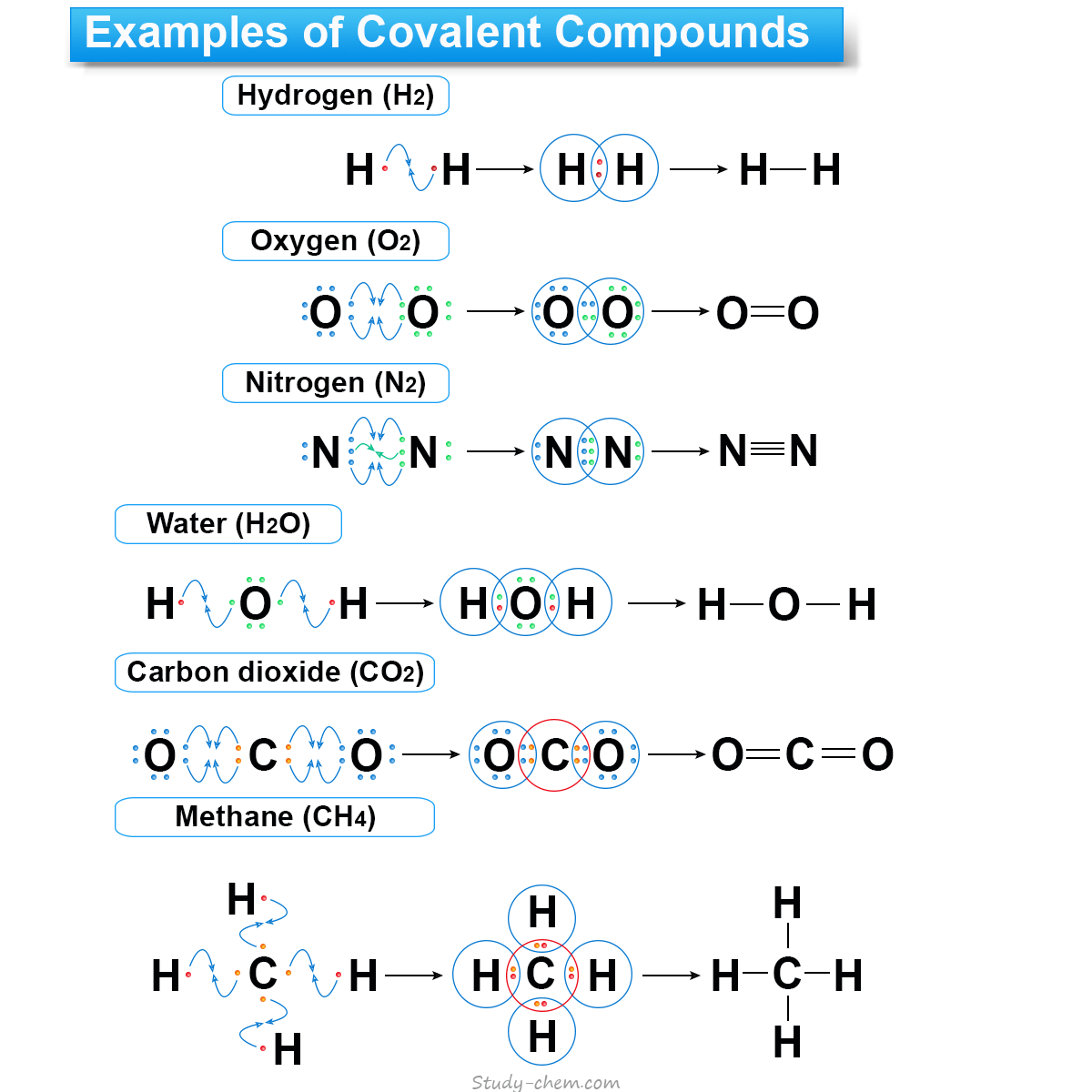
Hydrogen (H) is the simplest among all periodic table elements, and it contains only one electron. Therefore, it requires another electron from another hydrogen atom to achieve the nearest inert gas (helium) electronic configuration.
H + H → H−H
Therefore, two hydrogen atoms will bond together in a single covalent bond to form a hydrogen molecule (H2).
Oxygen (O2)
The atomic number of oxygen is 8 and the electronic configuration is:
O: 1s2 2s2 2p4
It has six electrons in its valence shell and two electrons needed to complete the octet. Therefore, two oxygen atoms will combine by sharing their two valence electrons to form a double bond (a sigma bond and a pi bond).
O + O → O=O
Nitrogen (N2)
The atomic number of oxygen is 7 and the electronic configuration is:
N: 1s2 2s2 2p3
It has five electrons in its valence shell and three electrons needed to complete the octet. Therefore, two nitrogen atoms will combine by sharing their three valence electrons to form a triple bond (a sigma bond and two pi bonds).
N + N → N≡N
Water (H2O)
A water molecule is formed by combining two hydrogen atoms and one oxygen atom. Hydrogen has only one electron in its valence shell and oxygen has a valency of two.
Therefore, each of the electrons from two hydrogen will share with oxygen to form the H2O molecule. As a result, two single bonds will be formed between hydrogen and oxygen.
H + O + H → H−O−H
Carbon Dioxide (CO2)
Two oxygen atoms and one carbon atom combine to form a carbon dioxide molecule. The valency of the oxygen atom is two and the carbon atom is four.
Therefore, each oxygen shares its two valence electrons with the carbon to form a double bond (one sigma bond and one pi bond). There will be a total of two double bonds formed in the carbon dioxide (CO2) molecule.
O + C + O → O=C=O
Methane (CH4)
One carbon (C) and four hydrogen (H) atoms combine to form a methane (CH4) molecule. The valency of carbon is four and hydrogen is one.
Therefore, each hydrogen will mutually share its one electron and form a single covalent bond with the carbon. There will be a total of four covalent bonds in methane, all of which are single bonds.