Chlorine Element
Chlorine is a yellow-green poisonous gas and a group 17 element, or halogen, in the periodic table with the chemical symbol Cl and atomic number 17. It is a poisonous or highly toxic gas that has a choking smell with the highest electron affinity and the third-highest electronegativity. Chlorine gas uses mostly as a disinfectant for treating drinking water and swimming pool water. Chlorine is also uses for making PVC plastics. Chloride ions play an essential role in the human body for balancing positive (sodium and potassium) ions.
We always use a gas mask when handling chlorine because it is a toxic gas and has been used as a chemical weapon. Chlorine is an extremely reactive and a strong oxidising agent that reacts with most of the periodic table elements. However, this halogen is a weaker oxidising agent than fluorine but a stronger one than bromine or iodine.
Occurrence
None of the elemental chlorine occurs in nature owing to its high reactivity. It occurs in nature generally as a mineral, halite (sodium chloride or common salt), and alkali and alkaline earth metal chlorides in seawater.
A large concentration of sodium chloride basically occurs in seawater and is deposited in lakes or salt beds by evaporation. Therefore, the chloride form of this element can be mined from several salt beds in the world.
The minerals carnallite (magnesium potassium chloride) and sylvite (potassium chloride) are also used for the extraction of chlorine gas. Each year, about 40 million tonnes of chlorine gas are made during electrolysis of brine or sodium chloride solution because it also produces sodium hydroxide as a byproduct.
Isotopes of Chlorine
Chlorine has 16 isotopes with mass numbers ranging from 31 to 46. Natural chlorine consists of the isotopes 35Cl (75.76%) and 37Cl (24.24%). However, the most stable radioisotope of this element is 36Cl.
Discovery of Chlorine
Hydrochloric acid was first discovered around AD 800 and was historically called by European alchemists spirits of salt or acidum salis.
The gaseous form of this element was first produced in 1774 by German-Swedish pharmaceutical chemist Carl Wilhelm Scheele when heating hydrochloric acid with the mineral pyrolusite (MnO2).
4HCl + MnO2 → MnCl2 + 2H2O + Cl2
He observed a dense greenish-yellow gas evolved and the gas had a choking odor. He dissolved it in water to form an acidic solution. The gas also bleached litmus paper, flowers, and leaves.
The Cornish chemist Humphry Davy investigated it in 1807 and officially announced in 1810 that it was not a simple substance but it was a new element. However, many yers also neeeded to acept chlorine is an element by many other chemists. The name of chlorine originates from the Greek word ‘chloros’ that means greenish yellow.
Production Process
Chlorine is generally produced in the laboratory by oxidation of HCl with MnO2 or KMnO4.
4HCl + MnO2 → MnCl2 + 2H2O + Cl2
Technically, Cl2 gas is obtained at the anode during electrolysis of molten or aqueous solution of sodium chloride. Metallic sodium and caustic soda or sodium hydroxide are the byproducts, respectively.
Electrolysis of aqueous NaCl basically gives different products under different conditions. The main reaction that happens during the electrolysis of aqueous sodium chloride is expressed as:
2NaCl + 2H2O → Cl2(anode) + 2NaOH + H2 (cathode)
The mercury cathode used during electrolysis of aqueous sodium chloride is gradually being discouraged owing to alarming mercury pollution through effluent water.
If the purpose of the electrolysis is to recover all the products, then the cell is constructed so that the anode and the cathode components are separated such that the chlorine cannot react with sodium hydroxide (NaOH) produced at the cathode. The possibility of replacing the traditional diaphragms with membranes is now being explored.
A porous membrane of Nafion (a copolymer of tetrafluoroethylene and a perflurosulphonyletoxy ether) reinforced with a Teflon mesh has good prospects.
Properties
The chemistry of chlorine follows from its electronic configuration and hence from its position in the periodic table. Therefore, the properties of this group 17 element are largely intermediate between fluorine and bromine. It has seven electrons in the valence shell, the distribution being two electrons in the s-subshell and five in the p-subshell.
Chlorine has only one electron short of the next noble gas, krypton. Thus, the noble gas configuration is achieved in two ways:
- By gaining one electron from the reactive surroundings and thus forming negative halide ions.
- By sharing its electron pair to form a covalent bond.
The tendency to accept one electron is so great because chlorine possesses the highest electron affinity in the periodic table.
Discovery and Physical Properties |
|||
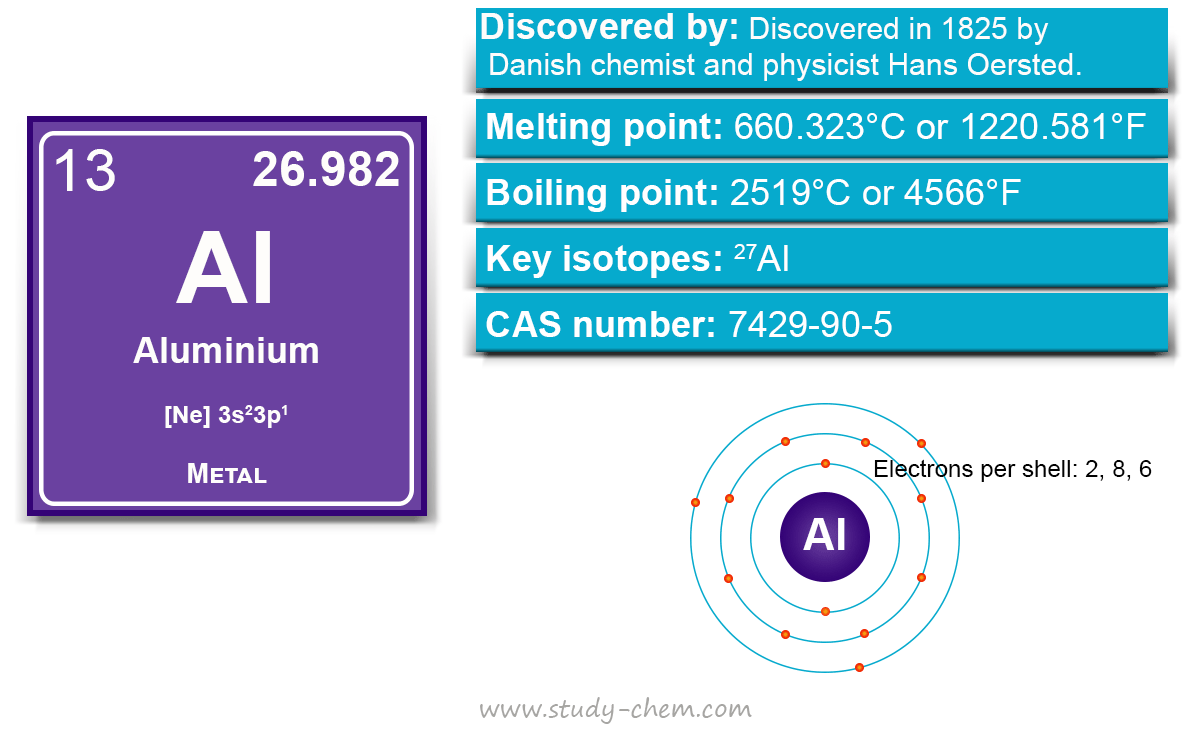
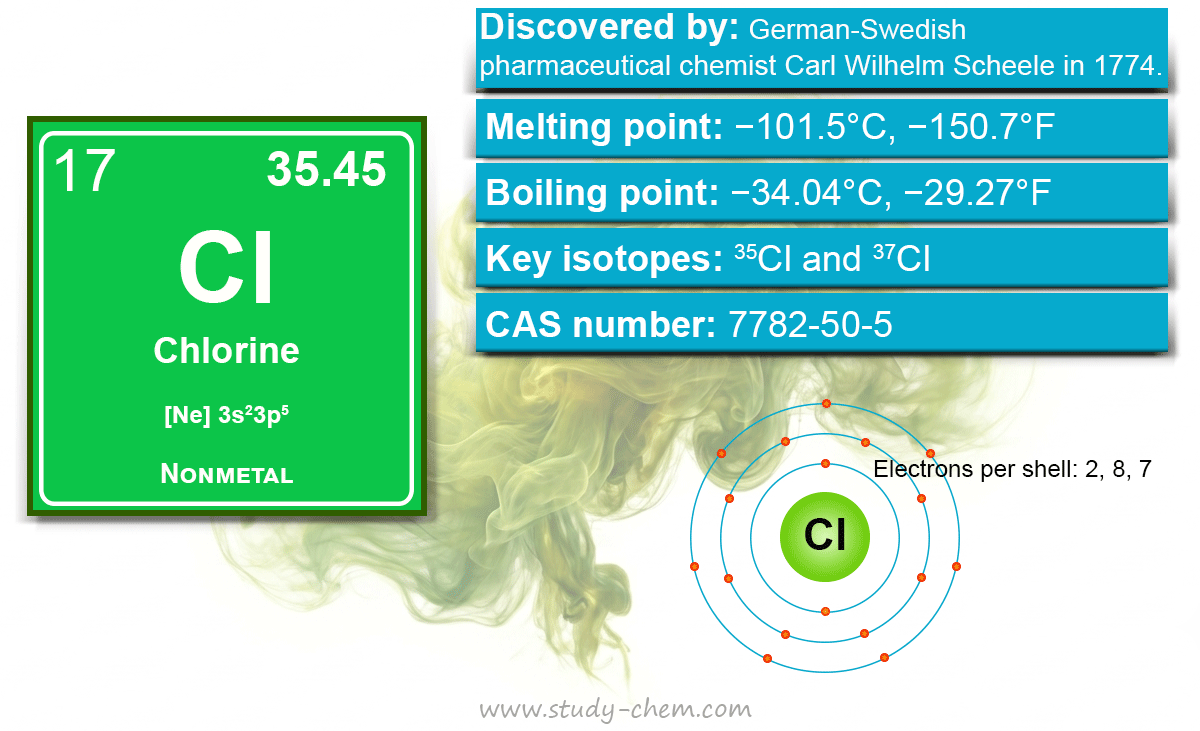
| Discovery | Discovered in 1774 by German-Swedish pharmaceutical chemist Carl Wilhelm Scheele. | ||
| Origin of the name | The name of this periodic table element originates from the Greek ‘chloros’, meaning greenish yellow. | ||
| Allotropes | Cl2 | ||
| CAS number | 7782-50-5 | ||
| Symbol | Cl | ||
| Relative atomic mass | 35.45 | ||
| Atomic number | 17 | ||
| Electron per shell | 2, 8, 7 | ||
| Electron configuration | [Ne] 3s2 3p5 | ||
| Periodic position | Group 17, period 3, and block p in the periodic table. | ||
| Melting point | −101.5°C, −150.7°F | ||
| Boiling point | −34.04°C, −29.27°F | ||
| Density (g cm−3) | 0.002898 | ||
| State | Yellow-green poisonous gas at 20°C | ||
| Crystal structure | orthorhombic (oS8) | ||
| Key isotopes | 35Cl (75.76%) and 37Cl (24.24%) | ||
| Critical point | 416.9 K, 7.991 MPa | ||
| Heat of fusion (Cl2) | 6.406 kJ/mol | ||
| Heat of vaporisation (Cl2) | 20.41 kJ/mol | ||
| Thermal conductivity | 8.9×10⁻³ W/(m⋅K) | ||
| Electrical resistivity | >10 Ω⋅m (at 20 °C) | ||
| Molar heat capacity | 16.9745 J mol−1 K−1 (Cl) and 33.949 J mol−1 K−1 (Cl2) | ||
| Specific heat capacity | 478.829 J kg−1 K−1 (Cl) | ||
| Speed of sound | 206 m/s (gas, at 0 °C) | ||
| Molar magnetic susceptibility | −40.5×10⁻⁶ cm3/mol | ||
Chemical Properties |
|||
| ChemSpider ID | 4514529 | ||
| Atomic radius, non-bonded (Å) | 1.75 | ||
| Covalent radius (Å) | 1.00 | ||
| Electron affinity (kJ mol−1) | 348.575 | ||
| Electronegativity (Pauling scale) | 3.16 | ||
| Ionisation energies (kJ mol−1) |
1st | 2nd | 3rd |
| 1251.186 | 2297.663 | 3821.78 | |
| Common oxidation states | 7, 5, 3, 1, -1 | ||
| Magnetic ordering | diamagnetic | ||
Chemical Reactivity
The nonmetal chlorine is a highly electronegative and most reactive diatomic gas belonging to the halogen family of the periodic table.
The bond dissociation energy of F2 is less than that of Cl2. This indicates that the F−F electron pair is less tightly held than the Cl−Cl electron pair. Thus, the fluorine atom will hold an extra electron to form the F− ion less strongly than the chlorine atom.
The gradual decrese in bond energy from Cl2 to I2 is consistent with poorer overlap with increasing size of overlapping orbitals. The reverse trend in fluorine molecules is assigned to large internuclear repulsion and inter-electron repulsion.
Chlorine is sparingly soluble in water, during which it disproportionates into HCl and HOCl. The oxidation of water by Cl2 is extremely slow, though the reaction is thermodynamically feasible.
Chlorine readily adds to ethene double bonds and oxidizes hydrogen sulfide to sulfur, arsenites to arsenates and sulphites to sulfates.
Compounds of Chlorine
Chlorine is just one electron short of the next noble gas krypton. Therefore, they generally accept one electron to show a negative oxidation state. However, they exhibit several positive oxidation states in its oxides, oxoacids and interhalogen compounds.
Halides of Chlorine
Almost all the elements in the periodic table except He, Ne and Ar form binary compounds with chlorine and give rise to a wide range of halides.
The halides may be simple ionic (NaCl, KCl, CaCl2, MgCl2, and BaCl2) or covalent (CCl4, PCl3, PCl5, and SCl2). Several polymeric, oxohalides, hydroxohalides, and complex chlorides are also formed by this element.
Hydrogen Chloride
Hydrogen chloride or hydrochloric acid has been known to chemists since around AD 800. Anhydrous hydrogen chloride is a colourless gas produced during the reaction between chloride salts and sulfuric acid. It basically ionises in aqueous solution due to solvation of the proton.
Oxides of Chlorine
Oxides of chlorine are unstable compounds but the higher oxides are rather more stable than the lower ones. The most common oxides of this element are Cl2O, ClO2, Cl2O6, and Cl2O7.
- A yellowish-red chlorine monoxide (Cl2O) is made by passing Cl2 over freshly precipitated mercuric oxide.
- Chlorine dioxide (ClO2) is a yellow gas and is used generally for bleaching wood pulp and for treatment of water. It is mostly prepared by heating silver chlorate at 90 degrees with dry Cl2 and by cooling.
- Dichlorine hexaoxide (Cl2O6) is obtained when mixing ClO2 and ozone at 0 °C. It is a red liquid that reacts with alkalis to give chlorates and perchlorates.
- Chlorine heptachloride (Cl2O7) is obtained by dehydrating HClO4 over P4O10 at −10 °C, followed by distillation at 85 °C.
Oxoacids of Chlorine
Chlorine forms oxoacids in oxidation states +1 (hypochlorous acid, HOCl), +3 (chlorous acid, HOClO), +5 (chloric acid, HOClO2), and +7 (perchloric acid, HOClO3). The oxoacids and their anions may be derived through sp3 hybrid orbitals on chlorine linking one or more oxygen atoms.
Interhalogen Compounds of Chlorine
Chlorine generally combines with other halogens to form interhalogen compounds. They mostly form diatomic interhalogens (ClF, BrCl and ICl), tetratomic interhalogens (ClF3 and ICl3) and hexatomic interhalogens (ClF5).
Facts of Chlorine
- Due to its high reactivity, most of the chlorine in the Earth’s crust occurs in the form of ionic chloride compounds.
- The electron affinity of fluorine is less than that of chlorine due to increased repulsion of the incoming electron by the dense population of nonbonding electrons in the small fluorine atom. The reverse is generally expected because fluorine is the most electronegative and most chemically active element among all the periodic table elements.
- The toxic and poisonous nature made chlorine as a chemical weapon in World War I by the Germans.
Position of Chlorine in Periodic Table
The atomic number of this periodic table element is 17, and the electronic configuration is [Ne] 3s23p5. Therefore, nonmetal chlorine is positioned in group 17 and period 3 of the periodic table.
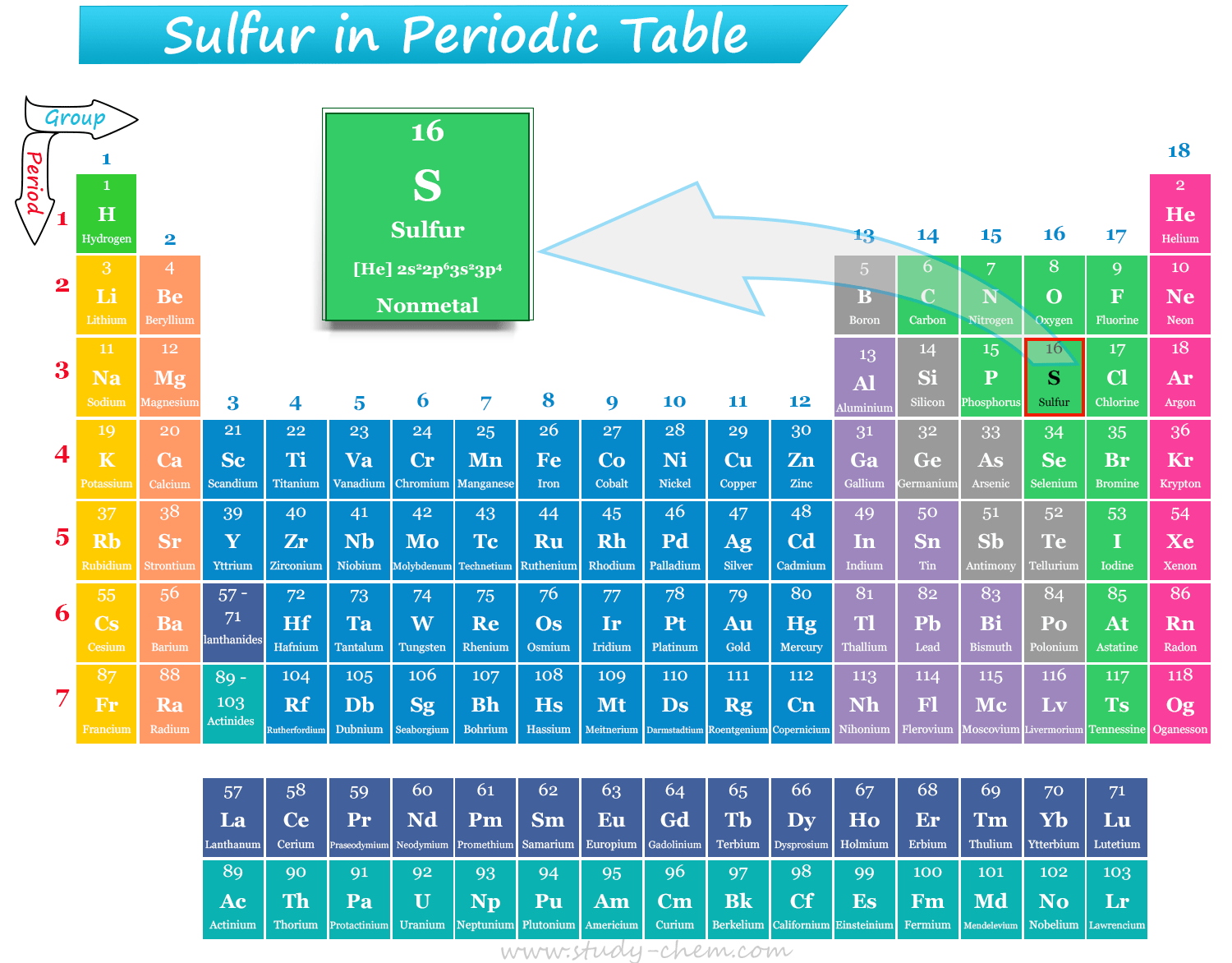
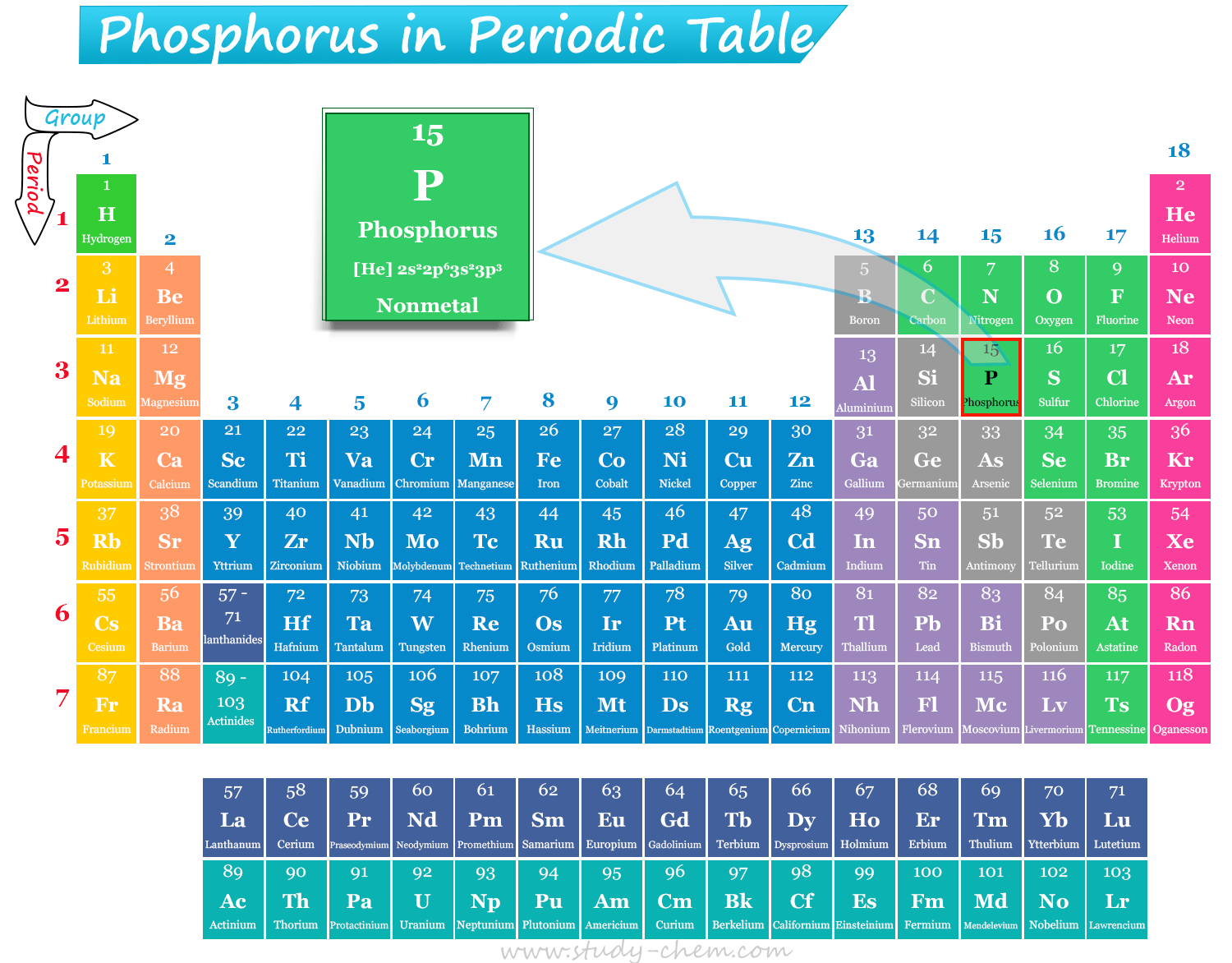
The valence shell electronic configuration of chlorine suggests that it is a p-block element, which is placed after sulfur and before argon along a period in the periodic table. Similarly, this periodic table element is placed in the halogen group below fluorine and above bromine.
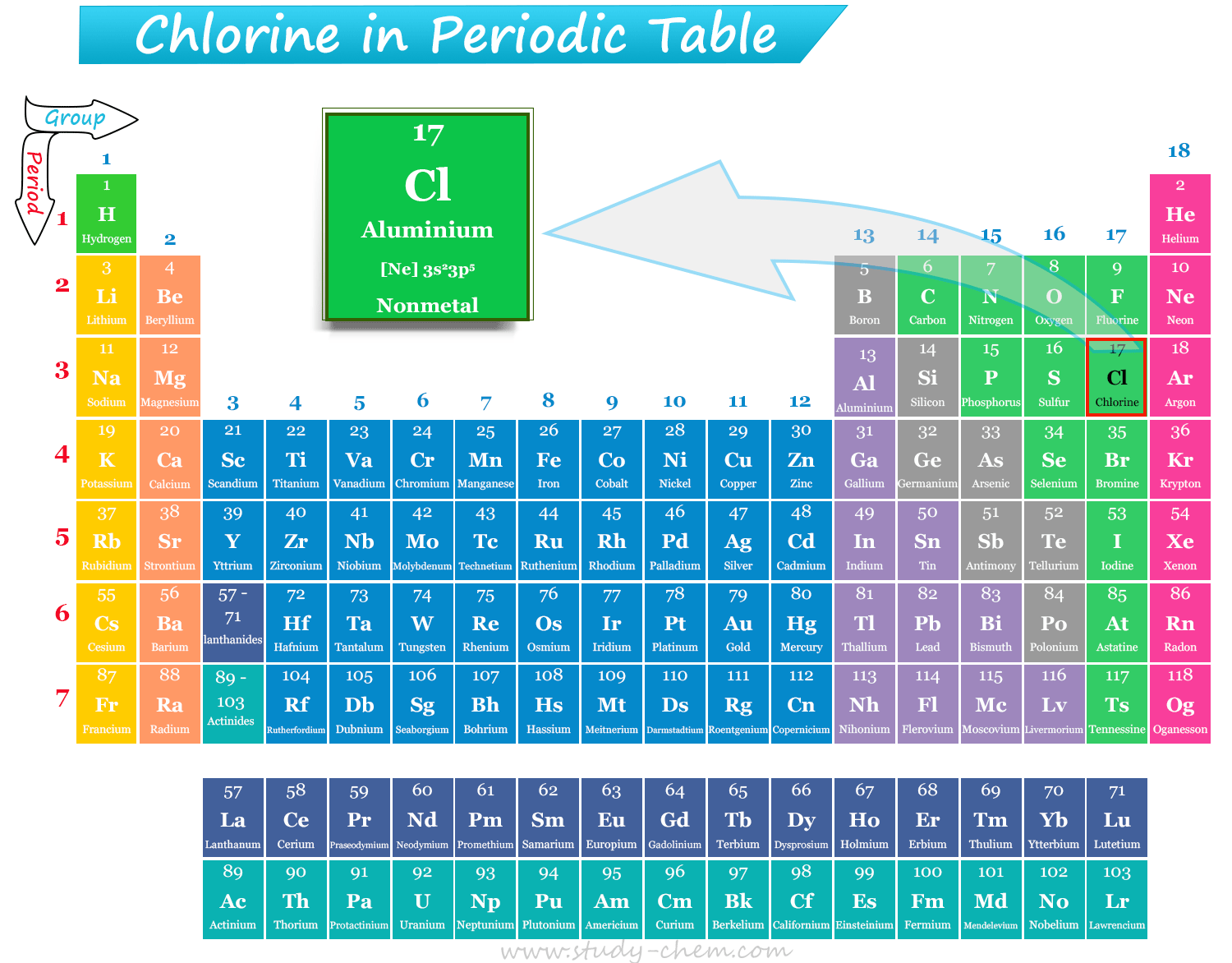
Chlorine is the 17th element, or the second member of group 17 or the halogen family of the periodic table. Therefore, this element is placed with other group 17 elements: Fluorine (F), Bromine (Br), Iodine (I), Astatine (At), and Tennessine (Ts).
Uses of Chlorine
Approximately 97 to 100 million metric tonnes of chlorine are produced annually in the world by most of the industrially developed countries. The main uses of chlorine are:
- Chlorine is a good disinfectant and is used mostly to kill bacteria in drinking water, swimming pool water, and sewage water.
- About 20% of chlorine produced in the world uses for the production of versatile plastic (PVC). PVC plays an important role in modern society during making window frames, car interiors, electrical wiring insulation, water pipes, blood bags, and vinyl flooring.
- Chlorine is also used widely for the production of chlorinated organic compounds such as ethylene dichloride and vinyl chloride.
- Chlorine or its compounds uses widely for the manufacturing of many medicines and pharmaceutical products.
- From paper to paints, and from textiles to insecticides, chlorine is used for making hundreds of consumer products, organic dyes, paints, solvents, explosives, etc. Therefore, this halogen uses extensively as a bleaching agent for the pulp, paper, and textile industries.
- In organic chemistry, chlorine is mainly use for oxidation and substitution reactions.
- Chlorine is used in the manufacture of hydrochloric acid and other inorganic compounds like NaOCl, CaOCl2, AlCl6, SOCl2, etc.
- Chlorine is also used in the past to make chloroform and carbon tetrachloride. These two chemicals are now strictly controlled because they can cause adverse effects on our liver.
- Due to its poisonous nature, chlorine itself was used as a chemical weapon during the First World War.
Biological Role
The chloride ion is an essential negative ion that is mostly present in cell fluid and blood to balance positive sodium and potassium ions.
This element is generally needed for the production of hydrochloric acid (HCl) in the stomach and in cellular pump functions. We get most of the chloride ions for our body from salt that we eat daily.
Toxic Effects of Chlorine
Watery eyes, skin rash, burns, shortness of breath, nausea, and vomiting are the most common side effects after Inhalation of chlorine gas. However, inhalation of a high concentration of Cl2 gas can cause pulmonary edema or even death.
Analytical Reaction of Chlorine
Hydrogen chloride can be oxidized by MnO2 to form greenish-yellow chlorine gas. Alternatively, the chloride under test can be mixed with K2Cr2O7 and concentrated H2SO4. It is heated until red-coloured CrO2Cl gas is evolved.
2NaCl + H2SO4 → Na2SO4 + 2HCl
4HCl + K2Cr2O7 + H2SO4 → 2CrO2Cl2 + K2SO4 + 3H2O
The gas is absorbed in alkali and the chromate thus produced is tested as lead chromate. The chromyl chloride test is based on the formation of HCl from the chloride. Hence, the test responds only to ionic chlorides.